Annette Weintraub Projects
annette(at)annetteweintraub.com
Video
Fringe Vision is an AI-assisted mixed reality artwork. It presents an eccentric landscape inhabited by discarded everyday objects. Based on extracted style images, the video combines AR screenshots, AI generated 3D objects and video, set against a complex sonic landscape.
This collaboration expands upon Annette’s work excavating an urban landscape littered by discarded household objects that are then altered and reintroduced into a synthesized urban space. The project research ranged widely, with images extracted from Annette’s panoramas that reappear in AR and VR environments created in Styly, including 3D models generated by Slavia in Meshy Ai, and in Biayna’s Unreal Engine flythrough of Los Angeles. Pierre’s Comfy UI video sequences used the extracted images to create a layered animation enhanced by his electronic soundscape.
Rather than presenting a seamless illusion, Fringe Vision foregrounds moments of dislocation and ambiguity, encouraging viewers to reconsider the environments they inhabit and the systems through which those environments are perceived. Set against a backdrop of New York, Los Angeles and Toronto, Fringe Vision explores the instability of perception within contemporary hybrid environments shaped by digital technologies. Familiar objects are displaced from their expected contexts and reintroduced into the physical world through augmented and virtual interventions. The resulting encounter creates a tension between recognition and uncertainty, inviting viewers to question the reliability of visual experience.
Credits: Fringe Vision is a collaboration between Annette Weintraub, Dr. Biayna Bogosian (Arizona State University), Dr. Slavica Ceperkovic (Senaca Polytechnic), and Dr. Pierre Jolivet (RISEBA University of Applied Sciences) created as part of the New Media Techspressionist Architectures Experiment curated by Joshua Dickinson, Gustavo Alfonso Rincon and Tuna Bora.

Under the Clock is a short video that uses the 3D modeled space of Waiting Room as stage set.
A railway waiting room becomes the backdrop for a series of experiences that examine the psychological effect of space. A discourse on travel, time and space, Waiting Room explores the anxieties of travel, feelings of displacement and the sense of isolation within public space and views space as narrative container, intertwining physical space and psychological state.
Credits: Annette Weintraub: concept, texts, design and narrative; Michael D. Wilson: Lingo scripting; Deborah Auer: Voiceover.
The interactive version of this project plays in Shockwave 3D Waiting Room [disabled]
Waiting Room storyboard
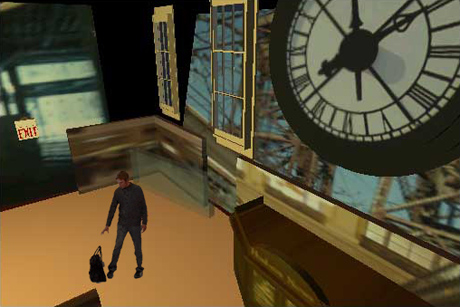
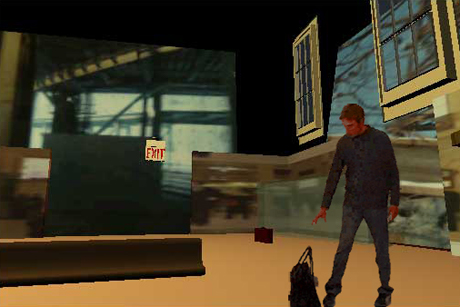
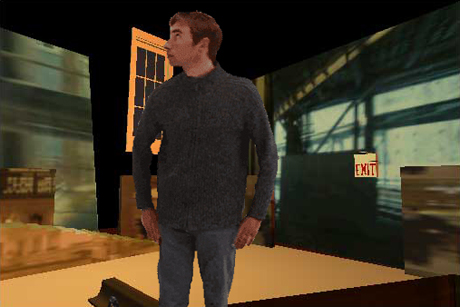
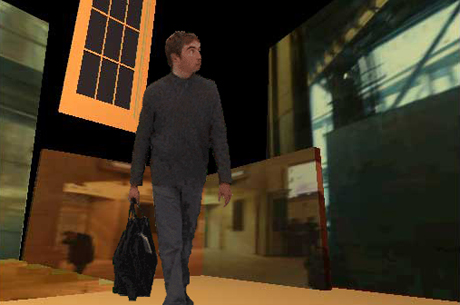
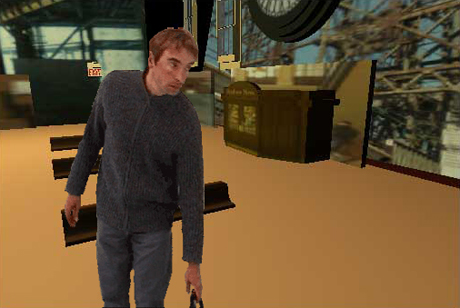
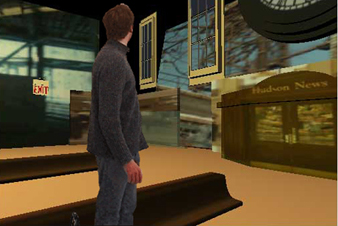
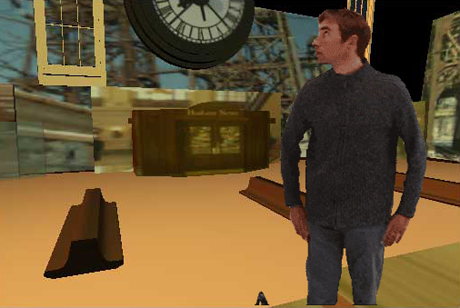
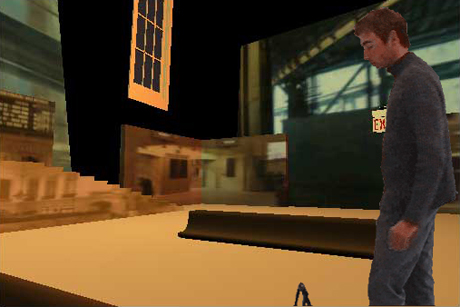
Waiting Room places multiple theatrical narratives within a hybrid representation of 2D/3D space. A railway waiting room becomes the set for a series of narrative experiences intensified by the psychological effect of the space. It explores themes of spatial/geographic dislocation, temporal disjunction and the anxieties of travel. Waiting Room was built in Cinema 4D, with interactivity designed in Director 3D using Lingo.
Below: stills gallery from the Shockwave interactive version from preset camera angles.
Day of the Dead tells the story of two encounters with death in the city. It contrasts the warmth of a ritualized remembrance with the brutality of sudden violence on the street.
On the Day of the Dead, a small apartment becomes a shrine. For twenty-four hours, every inch of space is covered with religious objects and artwork. The apartment glows with candles, colored lights and a corner of the living room is filled with mementos of friends who have died. For a day, the apartment is open to visitors who bring food, play music, laugh and dance. Minutes after leaving this magical tableau, the visitors come upon a murder on the street.
Day of the Dead is a reflection on death and the rituals that surround it; from the magic evocation of friendship through art, to the ritualized choreography of police and spectators.
Credits: Annette Weintraub: concept, texts, video and narrative; John Nielsen: Sound; Glen Santiago and Colin Chase: narration; Glen Santiago and John Hoge: Day of the Dead installation; The Butoh Rockettes: Patti Bradshaw, Celeste Hastings, Chris Maresca: Spirit dancers.
About Day of the Dead: http://contactzones.cit.cornell.edu/artists/weintraub.html